How it works

Six steps, none of them yours to write

Nothing is invented out of thin air. It all starts from what is already on your site.

01

We read the site

We start from your sitemap, or a shallow crawl if there is none. We respect robots.txt and never touch anything behind a login. Every page is classified by type — service, blog, contact — because a service page and a blog post are not written the same way.

Result: a knowledge base about the site, not an empty prompt.
02

We extract the business profile

From that text we derive what the company does, who it speaks to, what its advantages are, which cities it serves and the voice it writes in. That profile is what separates an article about your clinic from a generic article about teeth.

You can correct the profile before a single text is written.

03

We build a topic plan

The profile produces a list of topics for the period ahead, with dates. Articles target the questions people type; landing pages target services and locations. Topics that overlap with what is already written are dropped.

The publishing rhythm follows the plan: 20 a month lands as roughly one every working day, spread across the period.

04

We write in several passes

Not one prompt. First the structure, then the introduction, then each section separately, then the FAQ and conclusion. A section that comes out too short is written again. That is why the text has length and depth instead of five paragraphs of filler.

Alongside the text come the SEO title, meta description, JSON-LD and an image with alt text.

05

We check before publishing

Every text gets an SEO score and passes a quality check. Below the threshold it waits for you. Above it, it moves on — if that is how you set it up.

The score checks form, not truth. The last word is yours.

06

We publish where you said

WordPress, Webflow, Ghost, a GitHub repo, a hosted blog on your subdomain, a webhook, the public API — or straight to your email as HTML or Markdown if you'd rather skip the integration. We keep the originals, so your site can simply pull them: zero new tables, zero database on your side.

One site is allowed several destinations at once.

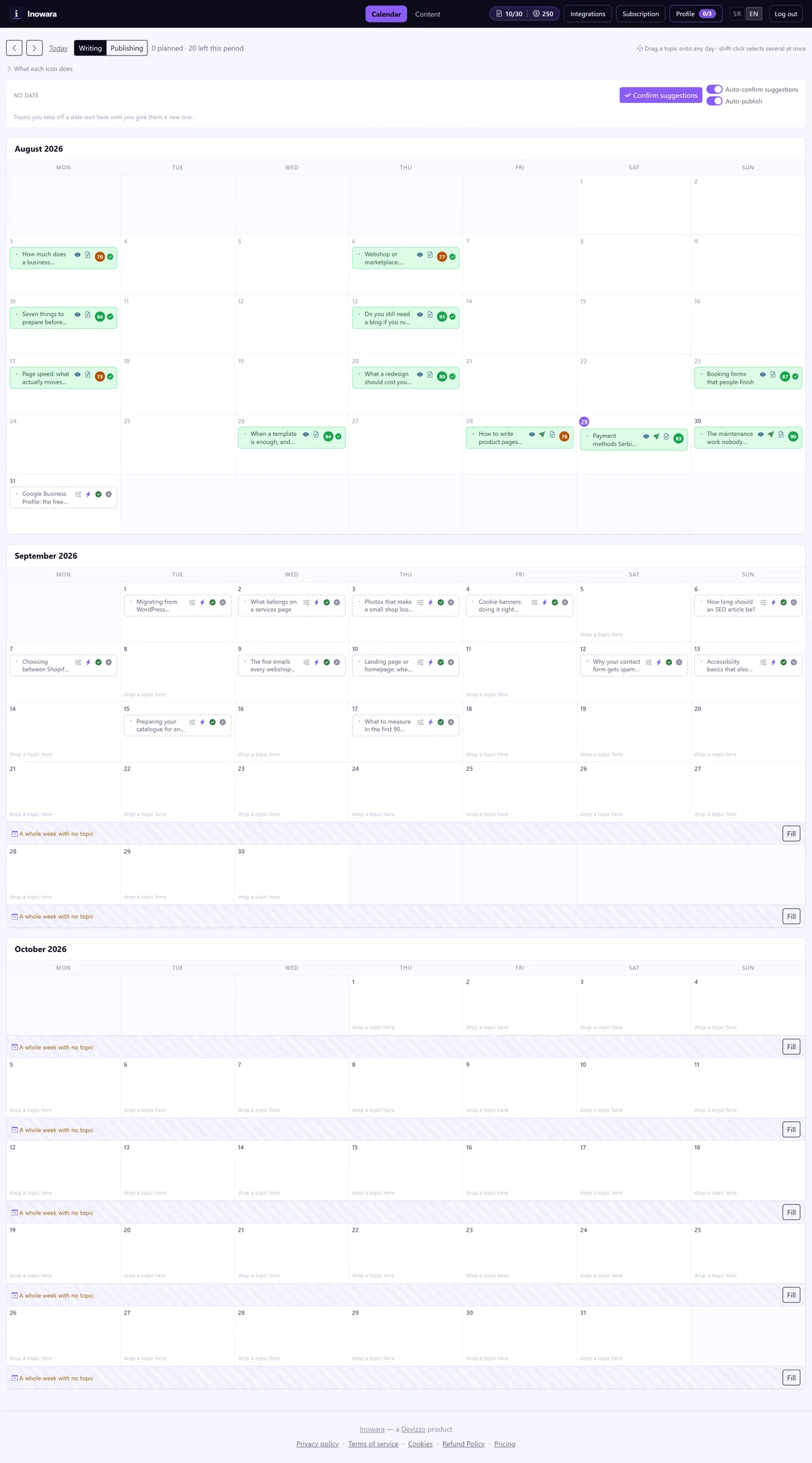
Inowara content calendar with planned topics, SEO scores and publishing state
The calendar the planner fills in — drag a topic to another day and it moves.
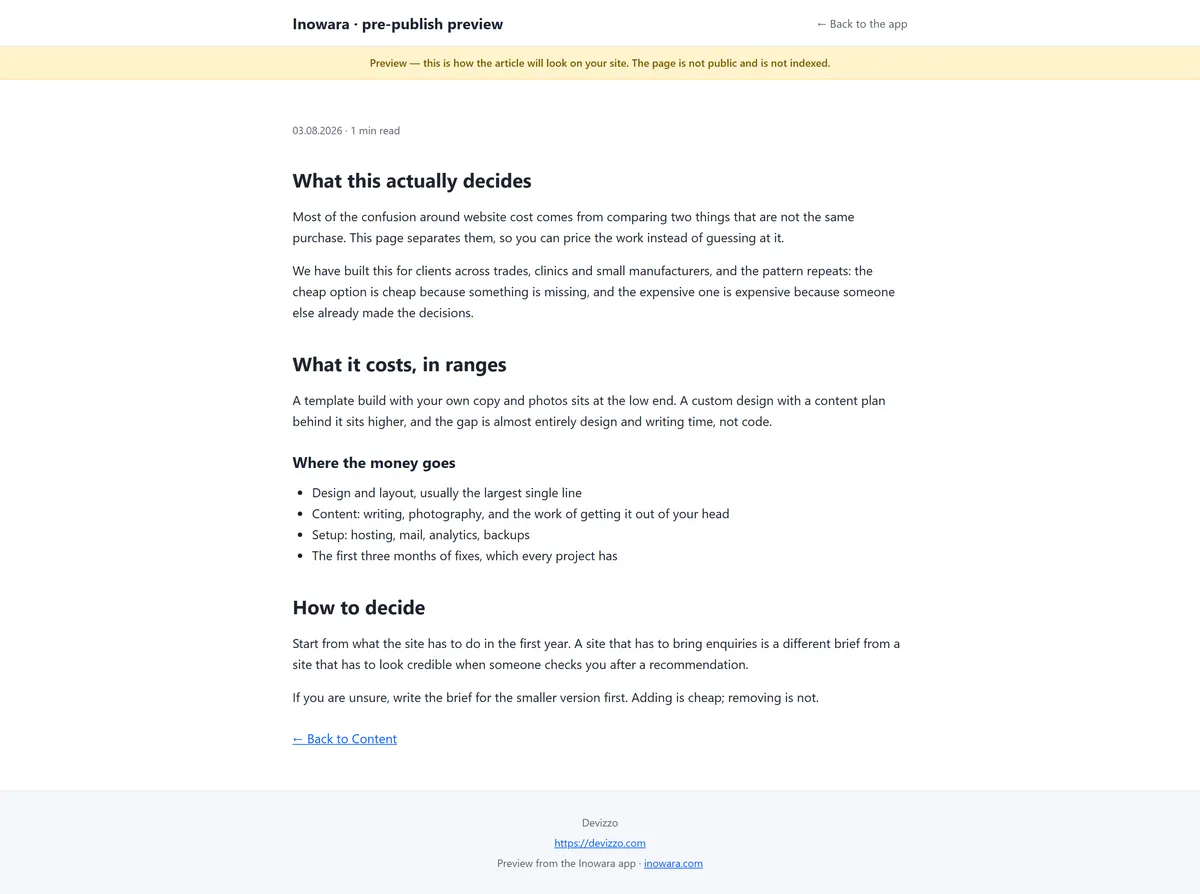
Pre-publish preview of an article as it will appear on the site
What the article will look like on your site, before anything goes live.

What this is not

So there is no misunderstanding

Not ChatGPT you paste a prompt into

You write nothing. The system knows what to write about because it read your site, and it publishes where you told it to.

Not a “10 tips” article generator

Topics come out of your services. If you do not do orthodontics, nothing is written about it, however popular the topic is.

Not a promise of first place

Nobody can guarantee rankings. What we can do is rhythm, structure and topic coverage — which is the part of SEO that is actually work.

Not recycled content

Every article is written fresh from your site's profile and checked against everything already published — no two clients ever receive the same text.

FAQ

Questions about the flow

How long until the first article?

The crawl and the profile are done the same day. The topic plan is reviewed by you, and that is usually the only step that waits. The first article can go out the next day.

Do I have to do something every week?

No. Once it is set up, the system plans, writes and publishes on its own. Your job is review — and you can switch that off once you trust what comes out.

What if a topic is no good?

You delete it from the queue or replace it. The topic plan is a list, not a decision set in stone.

Do the texts repeat themselves?

A new topic is compared against everything already queued and dropped if it sits too close to an existing one. That is why the plan does not circle the same topic in different words month after month.

Next step

Ready for organic growth?

Connect any site — services, webshop or blog. The plan builds itself, articles are written and published on schedule, and the first one is free.